island.recordsv0.1.0-alpharead-onlyroute: intake

A five-book literary series · LoadCanon

A program that made removal sound like mercy.

Island of Strangers is a literary speculative series about forced relocation — and the calm, administrative language that turns frightened people, on every side, into a problem a system can solve. It begins long before any island: in the towns and shelters where ordinary life is rearranged without consent, and in the offices where “one strike” and “voluntary transfer” quietly become the same sentence.

But “strangers” means more than the displaced. It is a civic condition — neighbors living side by side without a shared language for belonging, dissent, or forgiveness. Five books, one slow question: what happens when care, order, and safety begin to demand obedience?

Before the island

It starts with paperwork, not a shore.

Two books open the series in a world we'd recognize — where a crisis becomes a program, and a program learns to sound like rescue. No villains. Just fear discovering it can speak in policy.

Cover of Regional Prelude

The countries that broke

Regional Prelude

Twelve countries, the same fracture. Residents and newcomers alike live through one local flashpoint — a contracted hotel, a schoolhouse notice, an open-house inspection, a bus that stops feeling safe — as towns change faster than anyone agreed to. Twelve stories of ordinary people, and the conditions that make a system like NEMOS possible.

Read more · $9
Cover of Book 0 — Before the Island

How a crisis becomes a program

Book 0 — Before the Island

Analysts, language reviewers, call windows, transport routes, consent fields. The public story turns from punishment to opportunity: a relocation that is voluntary, paid, orderly, humanitarian. People go — some willingly, some because the alternative is worse. Book 0 follows the machinery as it learns to make removal sound orderly. The pipeline works.

Read more · $12

And then, an island no one chose

To survive, they build rules. The rules begin to repeat the system that sent them.

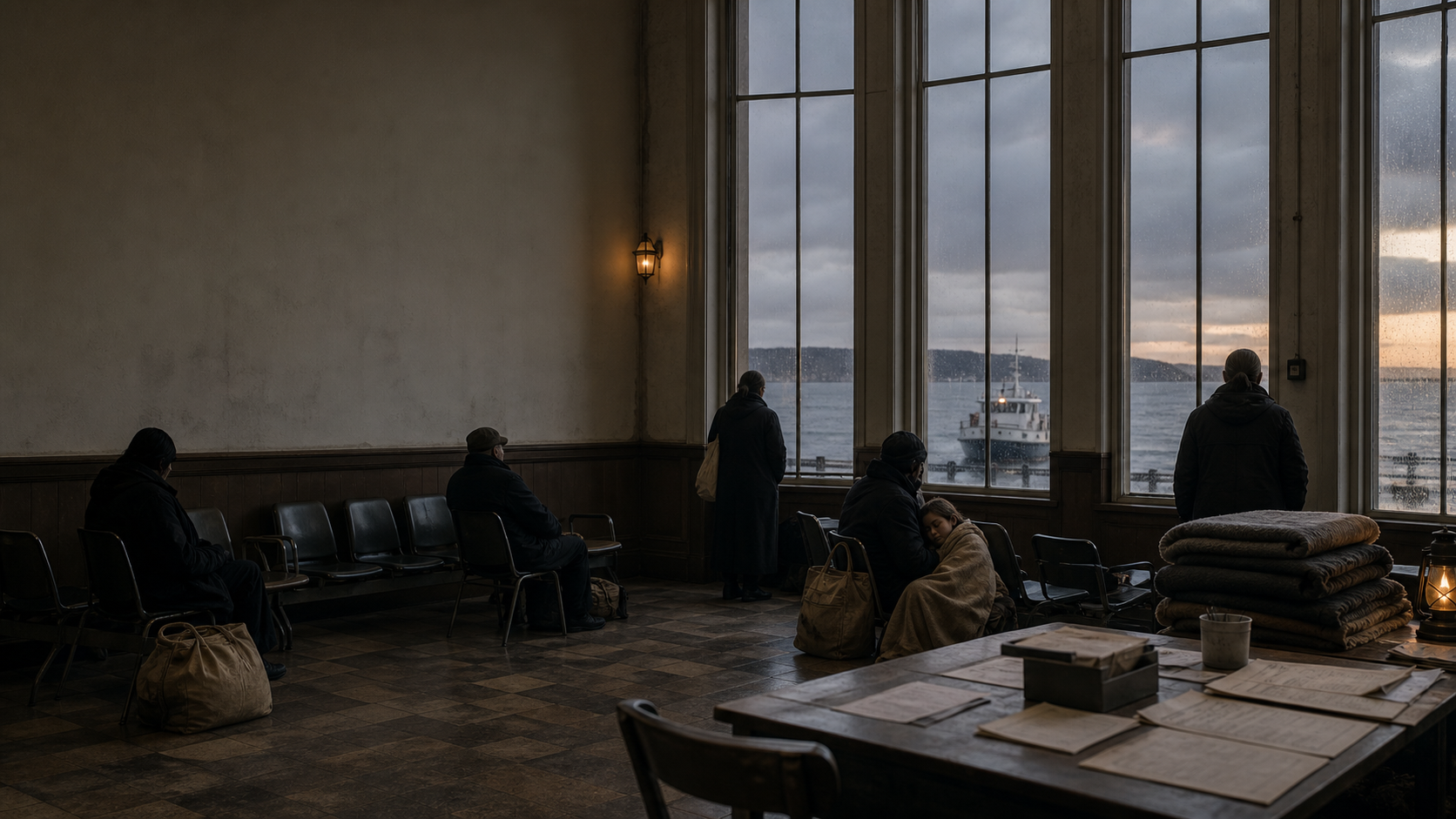
A mother steps off a transport boat with her infant against her chest — and the boat leaves. Around her: strangers from many languages and lives, supplies on the sand, and a calm broadcast welcoming them to renewal. There is no government waiting. To stay alive they need order; to stay human, they have to notice the moment order begins to own them.

The five-book cycle

Before, during, and long after.
The civic pressures that feed the system, the machinery that moves people, the first fragile settlement, the fracture, and the long reckoning. Read Book I on its own, or follow the whole arc.

Who you'll meet

Ordinary people, on both sides of a closing door.

The series gives the same seriousness to residents who feel the ground shift beneath them and to the strangers the system moves. No heroes, no single villain — only people deciding what they owe each other when the shared language for it is gone.

What the title means

Two meanings of “strangers.”

There is the literal island of displaced people. And there is the quieter condition the series is really about: neighbors who live side by side without a trusted, shared language for belonging, dissent, duty, forgiveness, or refusal.

A society loses its words first

Before institutions fail, the common grammar does. Moral confidence gives way to managed language, and dissent becomes a problem to be processed rather than answered. Strangers, here, is a civic condition — not only a migration one.

Faith and conscience, taken seriously

The books treat religious and cultural communities as sources of memory, conscience, and moral vocabulary — not as threats or decoration. Christianity carries older habits of duty and charity it no longer trusts; Islam, through Hafiz and others, is a living tradition under pressure. The weight sits on the system, never on a people.

How to read it

Read it as novels — or explore it as records.

Same series, two ways in. Neither is required; pick whichever suits you.

As the literary series

Five novels, read the ordinary way — chapter by chapter, beginning to end. Restrained, intimate, object-led literary fiction in the tradition of the quiet dystopia.

Browse the books →

Or through an AI

Load the same story as records — intake forms, transcripts, ledgers, broadcasts, the Charter — into ChatGPT, Claude, Gemini, or NotebookLM, and read the island through the documents it left behind. Eight reading routes; the AI cites the record behind every claim.

records/indexcanon
island-records/v0.1.0-alpha
·README_FIRST.md
·CHARTER.md
·consent-field.md
intake/
·form-014.md
·form-015.md
·form-016.md
records/
·arrival.md
·water-decision.md
·shelter-rotation.md
·petition-001.md
transcripts/
·radio-broadcast-0001.md
·meeting-transcript-0007.md
·bridge-transcript.md
ledgers/
·supplies.csv
·rotations.csv
·consent-log.csv
characters/
·amara.profile.md
·wexley-john.profile.md
·mateo.profile.md
schemas/
·record.schema.json
·consent.schema.json

Before you ask

A human-authored novel series — not a chatbot, not a game.

Whichever way you read it, the words are written by a person. The AI is only an optional way in.

this is

  • A human-authored literary speculative series
  • A story you read as records — intake forms, ledgers, broadcasts, the Charter
  • Read through the AI of your choice: ChatGPT, Claude, Gemini, or NotebookLM
  • A story you explore one record at a time, at your own pace
  • A five-book series about strangers building a society from emergency

this is not

  • AI-written or AI-generated fiction
  • A chatbot that invents the plot or answers as a character
  • A game with scores, levels, or fail states
  • Software you upload your own writing to
  • A normal ebook or PDF novel

Start

Begin with a free piece of the island.

A slice of Book I — Amara's first hour on the beach: the arrival broadcast, the supplies, the first form. Email only, no payment.

Common questions

The questions everyone asks first.

Is this written by AI?
No. Island of Strangers is human-authored, a five-book literary speculative series. The AI is only the reading interface — the records are the canon.
Is this an anti-immigration story?
No — and it takes care not to be. The series never makes any community the villain. It holds the fears, griefs, and loyalties of residents and newcomers alike with equal seriousness, and puts the weight on the system and the loss of a shared civic language. NEMOS is a program, not a stand-in for any real government or party.
What do I download?
A structured set of records: intake forms, transcripts, ledgers, broadcasts, character profiles, and the Charter. You load them into an AI platform and read the island one record at a time.
Where do I start?
Book I — Settlement is the doorway. It stands alone: a mother, an infant, and a crowd of strangers trying to build rules before fear builds them first. The Prelude and Book 0 sit before it; you do not need the full set to begin.
Do I need a paid AI account?
Mostly no. Most reading works on free tiers. Long sessions and the largest record sets benefit from a paid plan, but it is not required to begin.
Is it a game?
No. It is a literary speculative story released in a chat-native format. There are no scores, no fail states, and no branches you can lose.

source/records/index.md200 ok

intake form 0142 sealed